Skip to content
Back to experience

Role

Production Supervisor

Pasteurizadora Táchira (PAISA) · San Cristóbal, Táchira, Venezuela

Three years and one month in pure production within the food industry, under demanding quality and safety standards. I was responsible for the operation, configuration and preventive maintenance of the pasteurization equipment, supervised multidisciplinary teams of more than fifteen people across several departments, and managed the flow of raw materials and finished product.

The results I stand behind from this role are twenty percent less downtime, fifteen percent more productivity and twenty percent shorter delivery times, with full traceability. The plant also commissioned three studies on its own operation from me and trained me for twelve hundred hours as an Integral Technical Operator.

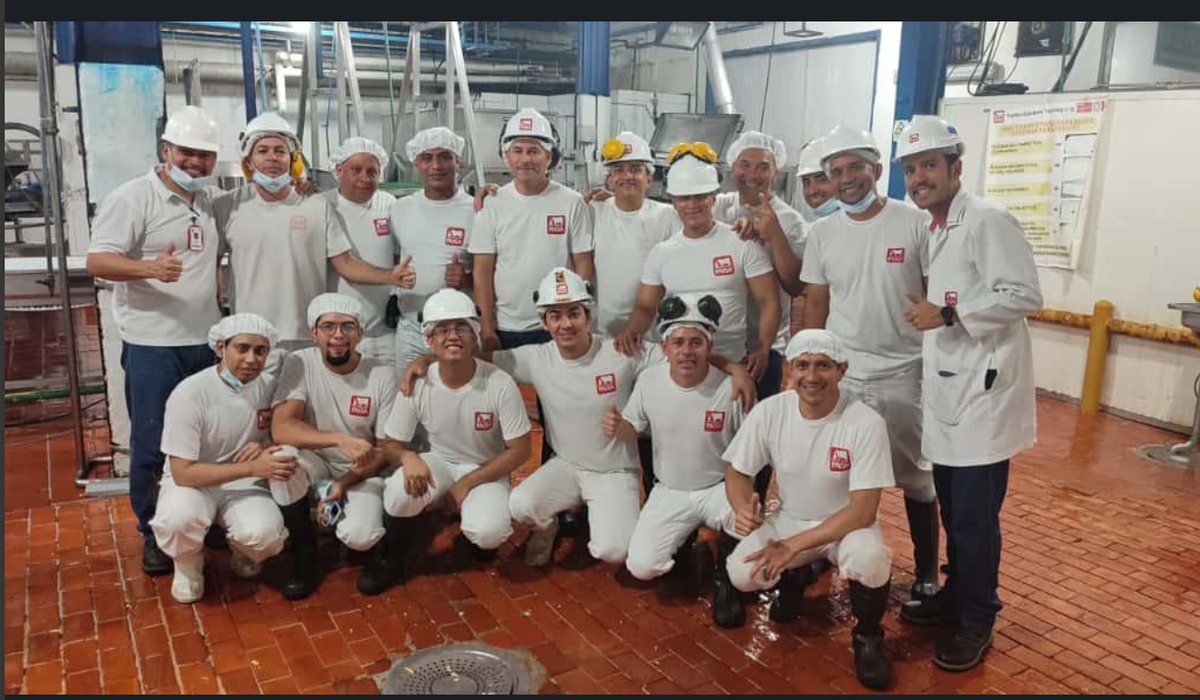
Production team at the plant
Pasteurizadora Táchira (PAISA)

Jul 2021 — Jul 2024

ISO 9001Lean · 5SPreventive maintenanceLeadership

  • Operations
  • People
  • Supply chain
3 yearsIn the roleJuly 2021 to July 2024
−20%DowntimePreventive maintenance procedures
+15 %ProductivityCumulative improvements to daily operations
1,200 hCertified trainingIntegral Technical Operator, in-house

My responsibility

Operation, configuration and preventive maintenance of pasteurisation equipment; supervision of multidisciplinary teams of more than fifteen people across several departments; raw material and finished product flow.

Result

−20% in downtime, +15% in productivity and −20% in delivery times, with full traceability.

The challenge

  • Perishable product: raw material with the shelf life running and a process bounded by temperature and time
  • Critical tasks that depended on the person who knew how to do them being present
  • The special white cheese line was discontinued and had no written process under ISO 9001
  • After the pandemic, production had fallen by more than 60 % and idle capacity was around 75 %

How I approached it

  1. Training as Integral Technical OperatorI completed the 1,200 hours of the internal programme while holding the role, focused on production process management and quality control.
  2. Preventive maintenance proceduresI turned into written routine what previously depended on the person who knew how to do it, to organise the operation so the stoppage would not happen.
  3. Supervision with ISO 9001, Lean and 5SI coordinated process, maintenance, quality and logistics per shift, with periodic reviews against production targets.
  4. Material flow and traceabilityI controlled perishable product stock between shortage and excess and maintained the traceability of each batch by manual means.
  5. Studies on the actual operationBetween 2022 and 2023 I produced three studies with data measured in the plant: standardisation of the white cheese, production planning and export to Chile.

System view

Excerpt from the standardized flow diagram
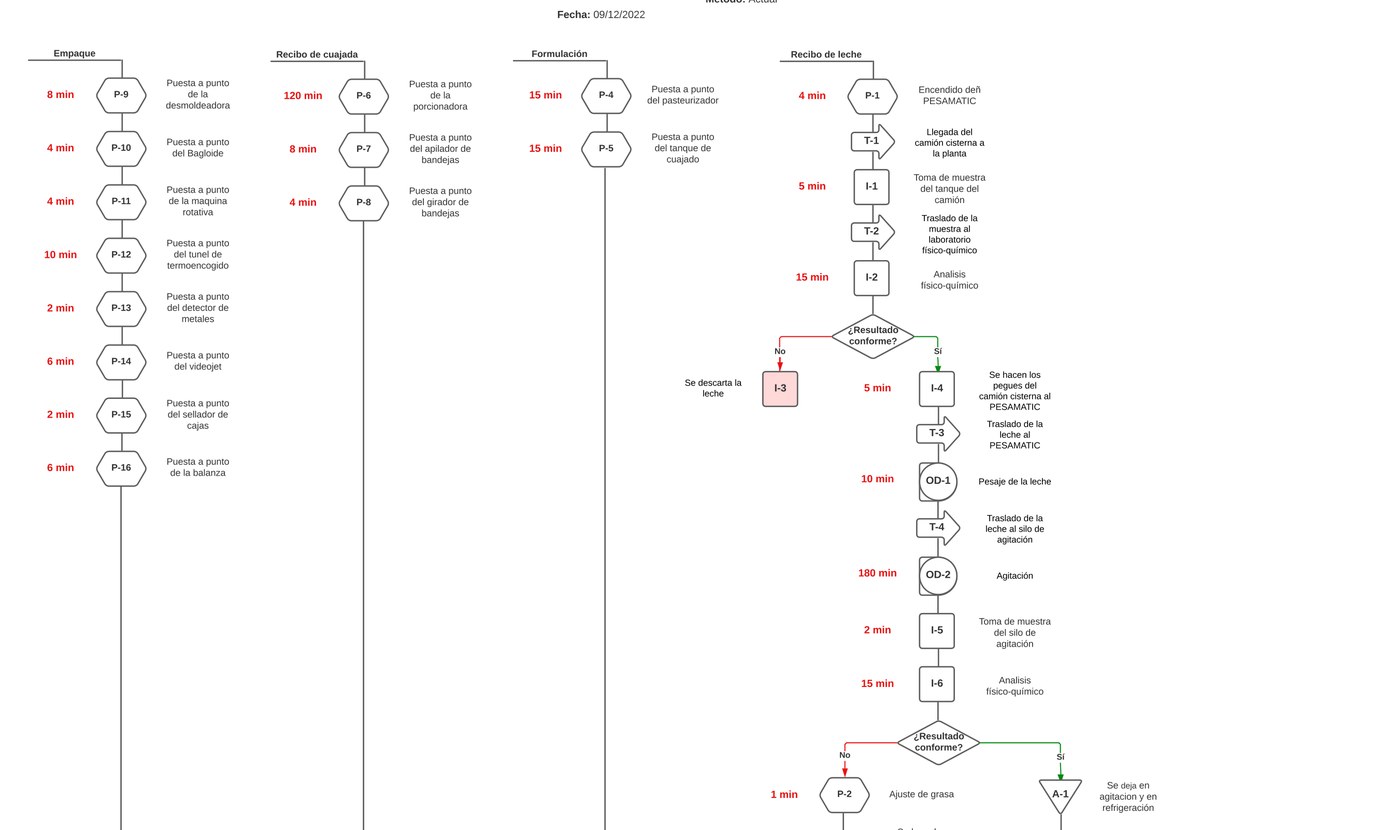
Excerpt from the standardized diagram, December 2022. On the right, milk reception with its physicochemical check and the non-conformity branch: if the sample fails, the milk is rejected before entering.Image edited for project confidentiality: operational data has been deliberately blurred or removed.

Work blocks

Pasteurisation equipment

I configured each piece of equipment to the batch parameters: the temperature and time pair is the critical parameter, and a miscalibrated sensor produces a batch that looks correct and is not.

Preventive maintenance

I implemented written procedures that reduced downtime by 20 %; a stoppage mid-process means discarding the product in progress and disinfecting before resuming.

Supervision of more than fifteen people

I coordinated process, maintenance, quality control and logistics operators on the same shift, planned the activities and ensured the staff's continuous training.

Logistics and traceability

I managed raw materials and finished product, controlled stock between shortage and excess and could reconstruct each batch by manual means: origin, parameters and destination.

Standardisation of the special white cheese

I mapped the four areas, from milk reception to packaging, with each operation and its time measured in the plant: 180 minutes of stirring, 15 of analysis, 120 of setup.

Export report for Chile

I compared Brazil, Japan and Chile by tariff and market gap; Chile won with 6 % and a market supplied almost only with fresh white cheeses, and I closed with the customs documentation.

01

The role

I joined Pasteurizadora Táchira in July 2021 and left three years and one month later. It's the longest role in my career and the only purely production-based one: the responsibility wasn't analytical or project work but operational and day to day. If a piece of equipment went down, it went down on my shift.

The product dictates everything else. Raw material arrives with a shelf life that is already running, the process has to run within a temperature and time window, and the finished product is still perishable after it leaves. An optimization that saves time at one stage but breaks the cold chain at the next is not an improvement, it's a product loss and a food safety problem.
02

Production and preventive maintenance

I was responsible for the operation, configuration and preventive maintenance of the pasteurization equipment. Configuring means setting the equipment to the parameters that batch's product needs; the temperature-time pair is the critical process parameter, and a heat exchanger that doesn't reach setpoint or a miscalibrated sensor doesn't produce a visible failure but a batch that looks correct and isn't.

I implemented procedures that cut downtime by twenty percent. The figure didn't come from a one-off fix but from turning into a written routine what used to depend on whether the person who knew how to do it was present. In a food plant, a mid-process stoppage forces the batch in progress to be discarded, requires cleaning and disinfection before restarting and pushes back the schedule for the following shifts, so the goal was never to react faster but to organize the operation so it wouldn't happen.

03

Team supervision

I held the position of Production Supervisor for several departments, coordinating multidisciplinary teams of more than fifteen people, planning activities and ensuring continuous training for staff. Multidisciplinary here meant coordinating process operators, maintenance, quality control and logistics on the same shift, each with a legitimate priority sometimes incompatible with the others.

I developed improvements that increased productivity by fifteen percent, cut costs and strengthened a culture of continuous improvement, with periodic reviews against production targets. I applied ISO 9001 practices and Lean and 5S methodologies, which in a food plant are not abstract frameworks: 5S has a direct effect on food safety, because order and cleanliness are hygiene conditions before they're industrial aesthetics.

04

Logistics and traceability

I managed the flow of raw materials and finished product, controlled stock levels and ensured a distribution that cut delivery times by twenty percent and improved traceability. Controlling stock for a perishable product means keeping two risks in check at once: stockouts, which halt production, and excess, which becomes a direct loss.

Traceability in the food industry isn't optional. For any given batch you have to be able to reconstruct which raw material it came from, when it was processed, under what parameters and where it was distributed, and be able to do so whenever someone asks. Here I handled it with manual means, years before building a system that did it automatically.

05

The studies the plant commissioned from me

Being a production supervisor while finishing an industrial engineering degree at the same time put me in an unusual position: I had the technical judgment to build a study and the daily access for the data to be real rather than estimated. That produced three papers between 2022 and 2023, all on the plant's actual operation.

They were the standardization of the special white cheese production process, a production planning plan, and a management report on exporting the product to Chile.

Standardizing the process

Excerpt from the standardized flow diagram
Excerpt from the standardized diagram, December 2022. On the right, milk reception with its physicochemical check and the non-conformity branch: if the sample fails, the milk is rejected before entering.Image edited for project confidentiality: operational data has been deliberately blurred or removed.

The special white cheese line had been discontinued and hadn't been updated to ISO 9001 standards: when it was restarted, the process didn't exist in writing in the terms the standard requires. Without a documented procedure there's no standard, without a standard there's no possible audit, and quality depends on who's on shift. I was asked to rebuild it and leave it standardized.

I mapped the four areas, milk reception, formulation, curd receiving and packaging, with every operation, transport, inspection, delay and storage step identified and its time measured on the floor: one hundred eighty minutes of stirring, fifteen of physicochemical analysis, one hundred twenty of portioner setup. Measuring a process you run every day turns the routine into something worth questioning, and that produced three lines of improvement: waste at the curd chamber outlet, the height adjustment on the portioner's discharge blades, and the lab bottleneck, which conditioned the whole sequence that followed.

The export report to Chile

Study of the Chilean market
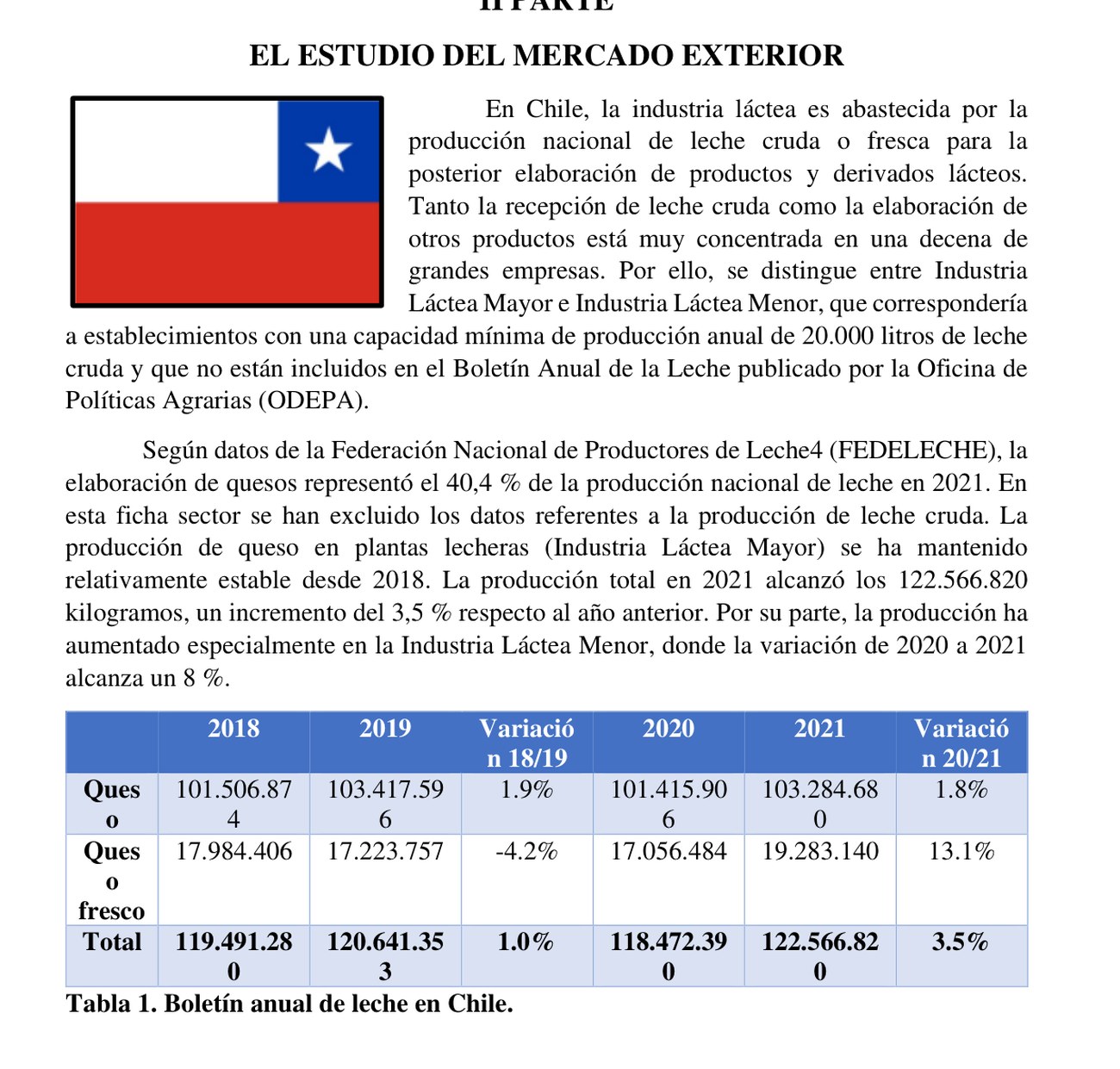
The Chilean market study, April 2023, with the trend in national cheese production between 2018 and 2021 according to ODEPA's annual bulletin.Image edited for project confidentiality: operational data has been deliberately blurred or removed.

The assignment had a concrete economic reason. After the pandemic, production had fallen by more than sixty percent, the plant was running one of its four shifts, and idle capacity stood around seventy-five percent, so exporting stopped being an ambition and became a way to fill capacity already in place. I shortlisted three markets and compared them by tariff and market gap: Brazil at 10.73%, Japan at 38% and Chile at 6%, the latter with further reductions under the Chile-MERCOSUR ACE 35 agreement. Chile won on the lowest tariff and on a market supplied almost entirely with fresh white cheeses, where an aged semi-hard white cheese could enter without competing head-on.

I documented market size with data from ODEPA and FEDELECHE, Chilean cheese production reached 122.5 million kilos in 2021 and cheeses accounted for 47.83% of the value of dairy imports, and closed with the operational side: a 2.8 kg bar, vacuum-packed and heat-shrunk, and the required customs documentation, bill of lading, cargo manifest, commercial invoice, packing list, insurance certificate and certificate of origin.

06

Training within the company

Integral Technical Operator certificate
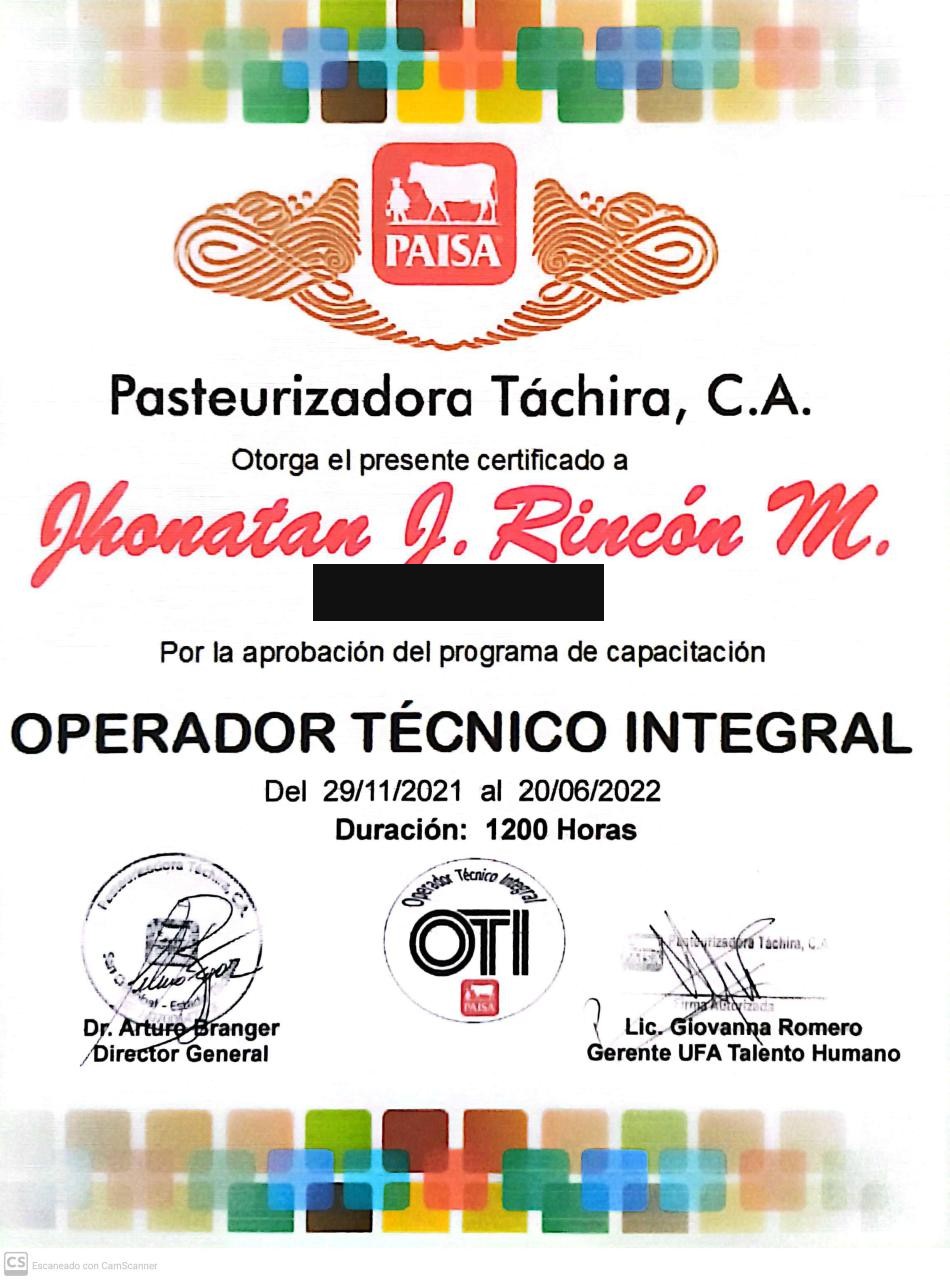
The Integral Technical Operator certificate, 1,200 hours between November 2021 and June 2022.

In November 2021 I completed the Integral Technical Operator program at Pasteurizadora Táchira: twelve hundred hours of intensive training in the food industry, focused on managing production processes and quality control.

Twelve hundred hours is roughly thirty weeks full-time, done while I held the position. I mention it because it explains where the process knowledge I applied daily came from, and because it's the kind of qualification that doesn't show up on a résumé unless it's spelled out: it's not a course, it's full training earned on the site where the work is done.

Results and impact

Result

−20 % in downtime

The result of preventive maintenance procedures, not of a one-off intervention.

+15 % productivity

Cumulative improvements to daily operation, with cost reduction and periodic reviews against production targets.

−20 % in delivery lead times

With full traceability: for each batch, which raw material it came from, when it was processed, with which parameters and where it was distributed.

Three improvement lines identified

From the standardised process came the waste in the curd cold rooms, the readjustment of the portioning machine blades and the laboratory bottleneck.

Stack

ISO 9001Lean5SPreventive maintenanceLeadership

Skills used in the role

Domain

Inventory management

Frameworks and methods

Lean manufacturingOperational excellenceTeam leadershipProcess optimisation5SISO 9001