
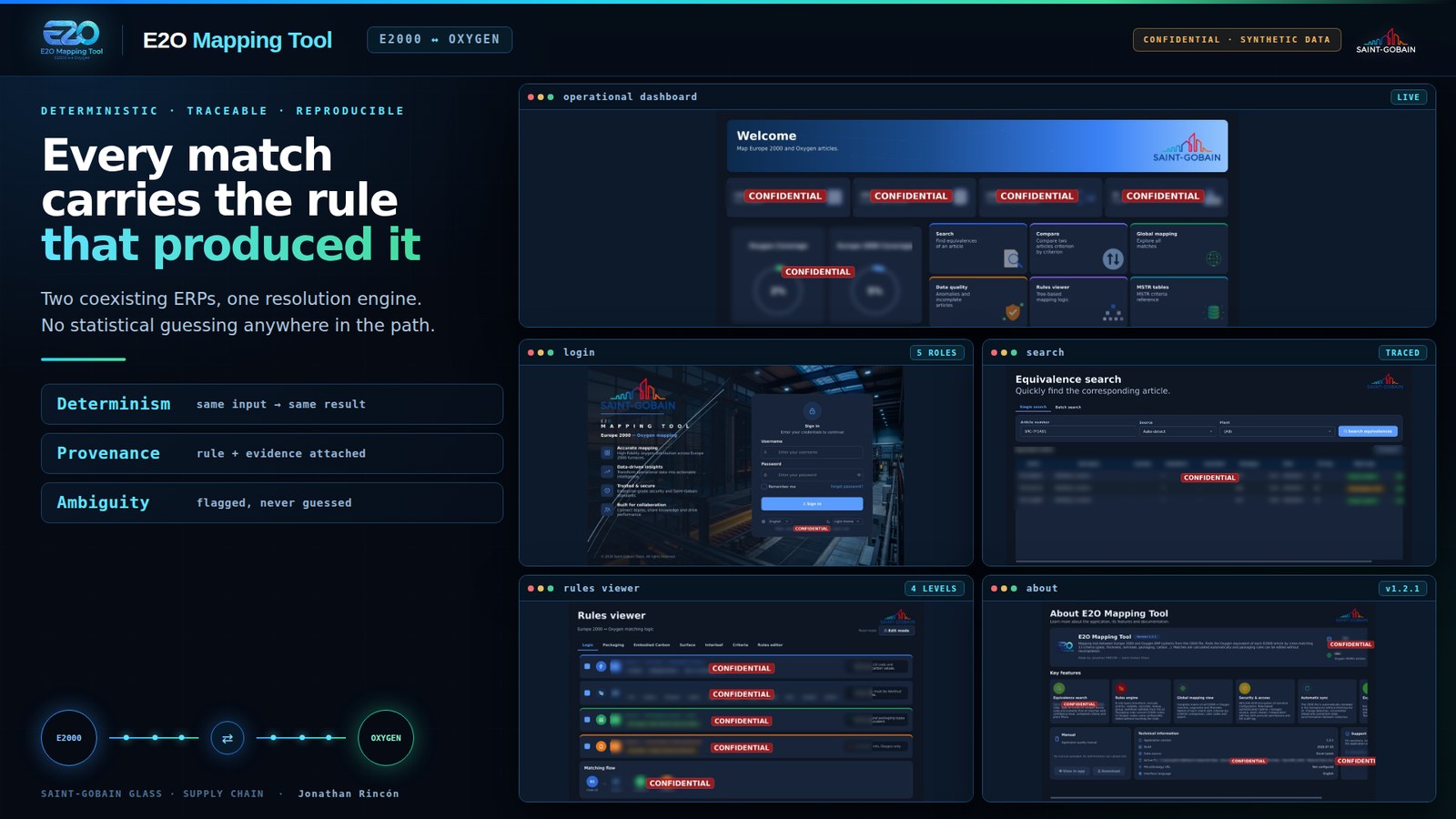
- Scope
- ≈120,000 legacy references
- Architecture
- Engine decoupled from data access
- Delivery
- 17 views, self-updating executable
- Documentation
- 87-page manual, 25 procedures
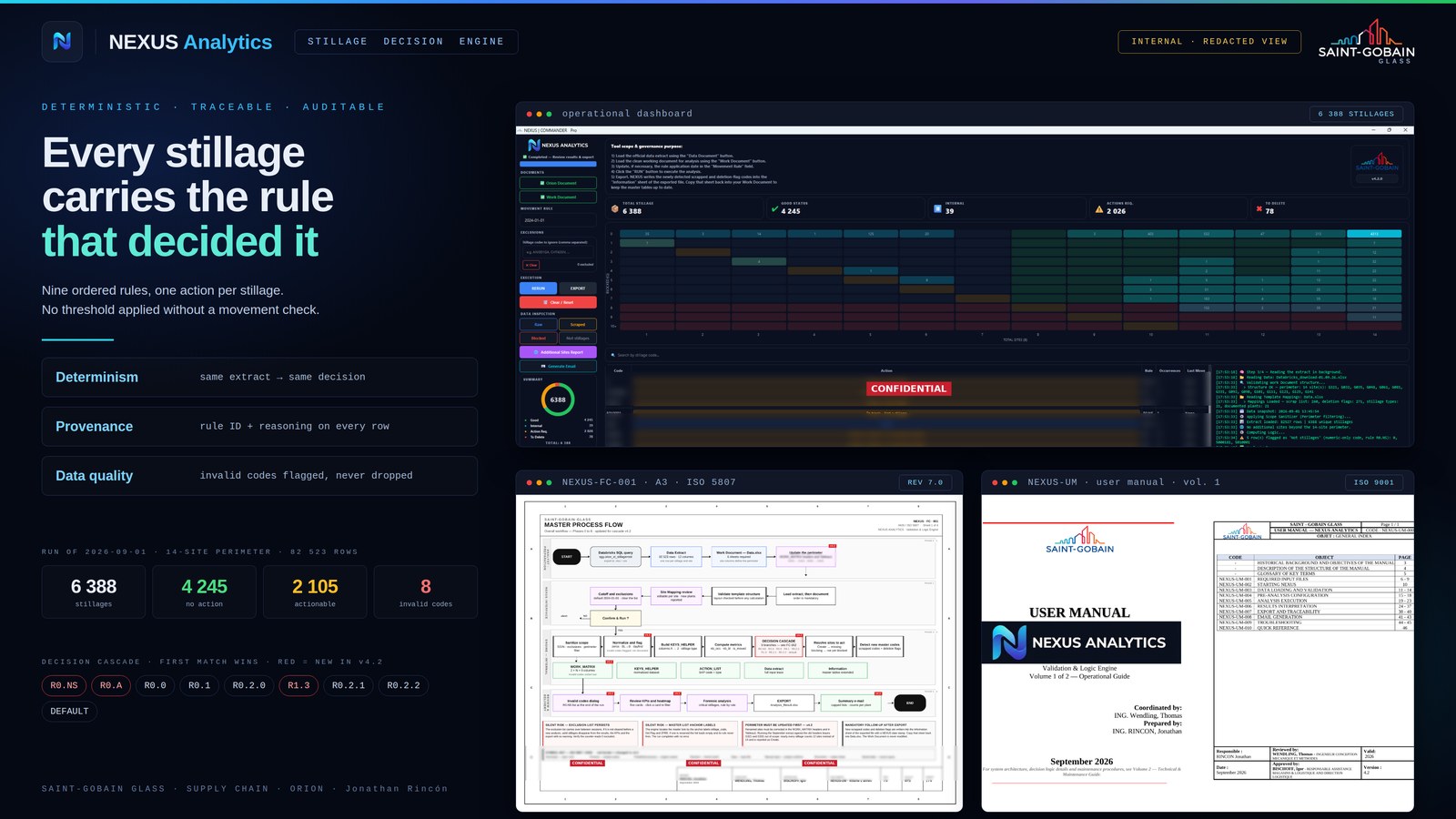
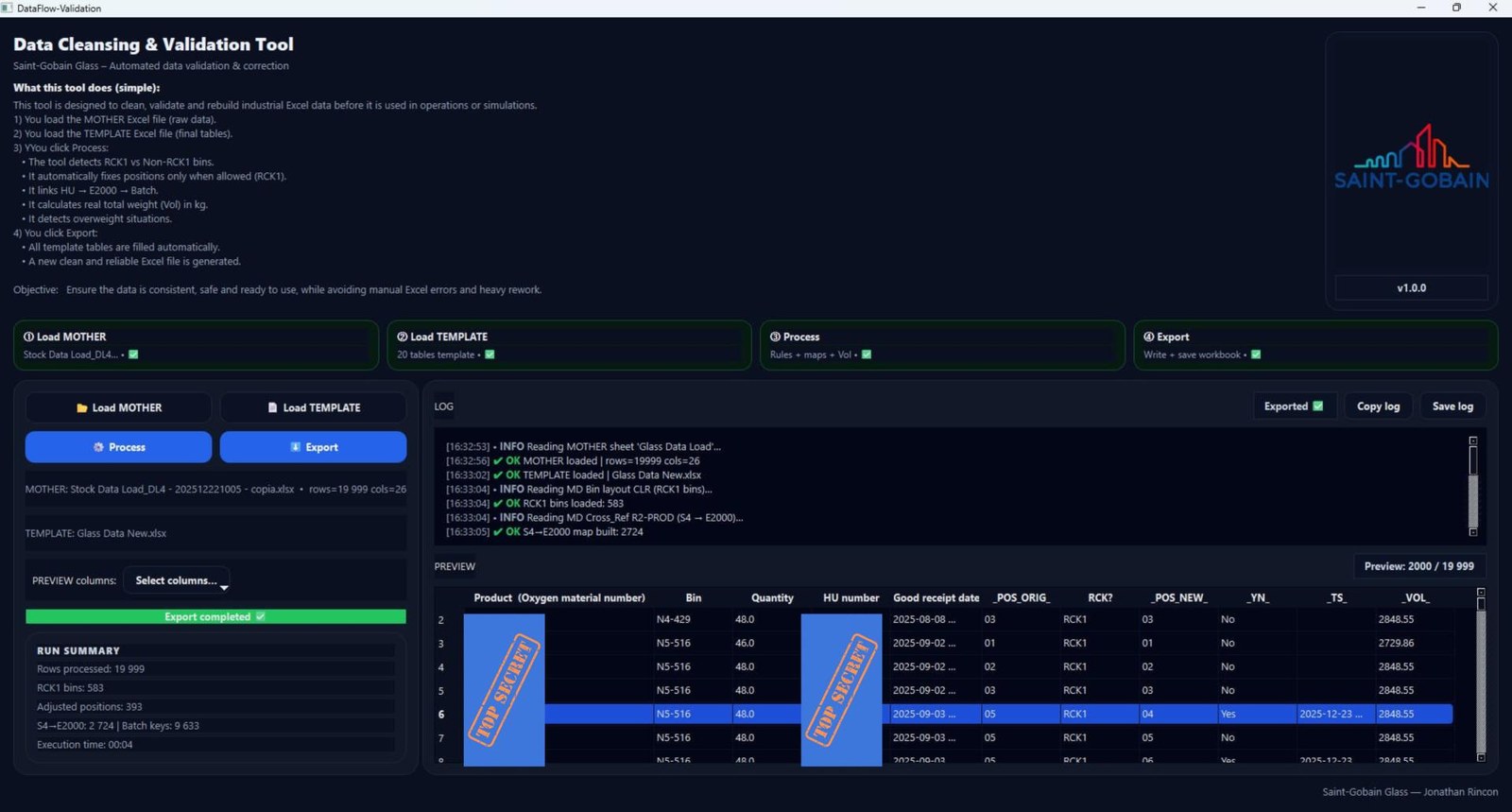
When Saint-Gobain Glass opened the transition from the Europe 2000 ERP to Oxygen, a problem appeared that no commercial tool solved: deciding which item in one system corresponds to which in the other. With on the order of one hundred twenty thousand legacy references across a multi-plant European scope, the matching was done by hand and depended on each analyst's judgment. I built E2O to turn that subjective judgment into a reproducible, governed and traceable system.
The underlying decision was to reject statistical similarity. An eighty-seven percent confidence score doesn't tell the analyst what to do and hides the ambiguity. E2O normalizes each reference's technical attributes and evaluates explicit business rules in a fixed priority order: same input, same result. When the criteria fall short it doesn't guess, it flags the ambiguity for human review, and each row carries the rule that produced its decision.
The hardest component wasn't the engine but the rules viewer: a spreadsheet-like environment connected to the engine, where authorized profiles modify parameters with validation, permissions, auditing and controlled propagation, synchronized across users without recompiling. It closes with hierarchical profiles, a vault encrypted in AES-256-GCM with Argon2id and a complete log.